Skip to content

San Marco · Jacksonville, Florida 32207

Monday–Friday, 7:30 am – 5:30 pm

(904) 893-3248
Sub-Zero Service San Marco
Menu

The Sub-Zero Line · 400 Series Wine

Sub-Zero 400 Series Wine Cabinet Repair

The cabinets that anchor most of San Marco's established wine rooms — and the dual-zone faults that quietly threaten a cellar.

Sub-Zero Service San Marco repairs the 400 Series wine line — the 424 and 427 cabinets of 1999 to 2016 and the related 430 — across San Marco and San Jose, ZIP codes 32207 and 32217. Dual-zone sensor drift, evaporator icing, and glass-door condensation are the usual faults and resolve between $250 and $1,200.

For Sub-Zero repair across San Marco and the river streets, ring the workshop at (904) 893-3248 or book online.

Series notes current as of 13 June 2026

(904) 893-3248 · Monday–Friday, 7:30 am – 5:30 pm

The Cabinets

What Are the 424 and 427, and Why Do They Endure?

The Sub-Zero® 400 Series defined built-in wine storage for a generation. Produced from 1999 to 2016, the line centered on two cabinets: the narrower 424 and the wider 427, each offered with glass or solid doors and in refrigeration variants, alongside the related 430. They were the cabinets specified when San Marco's riverfront houses built proper wine rooms — a 427 standing in a converted butler's pantry, a 424 worked into a bar wall — and a great many of them are still on duty two decades later.

Their endurance is also why they fill our wine calls. A cabinet built to hold two climates at once — upper and lower zones a cellar's width apart in temperature — depends on sensors and seals that age, and Florida's humidity presses on both. Sub-Zero Service San Marco repairs the full 400 line across 32207 and 32217; the workshop line is (904) 893-3248, and visits can be requested through our online booking page.

We are also candid about parts. A line this long-lived means a 2002 424 and a 2015 427 do not share every component, and some original boards are now rebuilt rather than bought new. We identify the exact model and serial first and tell you honestly which parts are plentiful and which call for patience.

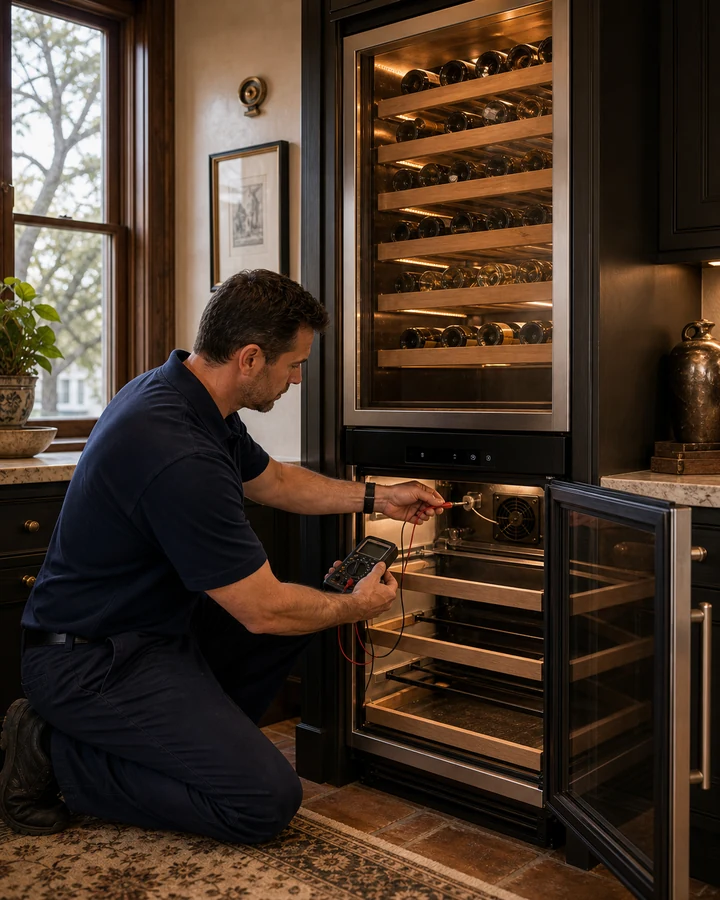
Sub-Zero 427 dual-zone wine cabinet opened for thermistor testing in a San Marco wine room

The Ledger

Symptom, Likely Source, and Working Figure

Symptom Likely source Working figure
Upper and lower zones reading degrees apart Thermistor drift in one zone's sensor $250–$450
Cabinet warming by day, recovering at night Evaporator icing — defrost or airflow, humidity-aggravated $350–$700
Glass door streaming, not just misting Door seal or glass-edge heater circuit $300–$600
Water behind or beneath the cabinet Condensate drain or pan overwhelmed in a warm room $250–$500
Compressor constant, both zones warm Refrigerant loss or condenser failure — evidence before estimate $700–$2,000

Matters of Record

Numbers That Hold Up for 400 Series Owners

The 424 and 427 ran from 1999 to 2016

Seventeen model years, across glass-door, solid-door, and refrigeration variants. The oldest cabinets in San Marco wine rooms are now past twenty, which is exactly the age at which sensors drift and seals harden — and why most 400 calls are sensor and seal work rather than anything graver.

A wine unit fails slowly, which makes early action cheap

Unlike a refrigerator, a wine cabinet rarely fails overnight; it drifts a degree at a time while the bottles warm politely. Caught when the display and a separate thermometer first disagree, a 400 cabinet is usually a modest sensor repair. Left to run, the same drift can cook a cellar before anyone notices.

Replacement means cabinetry, which keeps repair sensible

A current Designer wine column rarely matches the exact opening a 424 or 427 was built into, so replacement usually drags carpentry along with it. On a cabinet with sound refrigeration, that math keeps a sensor-and-seal repair the clear choice in most San Marco wine rooms.

The Catalog

The 400 Line by Model and Suffix

The number gives the cabinet; the suffix gives the door and the configuration. Both belong in any parts conversation, because a glass-door 427G and a solid-door 427S do not share every component.

Model Cabinet & door Production span
424G / 424FSG Narrower cabinet, glass door 1999–2016
424S Narrower cabinet, solid door 1999–2009
427G / 427RG Wider cabinet, glass door and refrigeration variant 1999–2015
427S / 427RS Wider cabinet, solid door variants 1999–2009
430 Related 400-line wine cabinet 1999–2009

Diagnostic Tells

How a 400 Cabinet Announces Its Faults

A wine cabinet rarely fails loudly; it confesses in small, ignorable ways months ahead of trouble. Learning the early tells turns a cellar-threatening drift into a forty-dollar sensor visit.

  1. The zones disagree. When the display and an independent thermometer in each zone diverge, a thermistor has begun to drift — the single most common 400 fault and the cheapest to fix early.
  2. One rack warms while the other holds. A split between upper and lower zones is sensor drift, not refrigeration; the healthy zone proves the sealed system is fine.
  3. The glass streams rather than mists. Light August fog is the dew point on cold glass; a door that genuinely runs points to a tired seal or a failed glass-edge heater.
  4. Water appears behind or beneath. A condensate pan or drain overwhelmed in an unconditioned pantry — a placement issue as much as a part.
  5. Both zones warm, compressor constant. Only now is the sealed system implicated, and the work moves to the refrigerant bench, proven before priced.

Read in that order, a 400 cabinet almost never surprises its owner with a large bill. The full service overview — zones, seals, condensate, and the humidity that drives them — sits on the wine storage page; ring (904) 893-3248 with the model and serial off the door frame.

Case Notes

A 427 in a River Road Pantry, Saved by a Sensor

Educational diagnostic scenario

Consider a glass-door 427 built into a converted butler's pantry off a River Road dining room, the kind of room San Marco does so well. The complaint arrived as two: the upper rack ran warm, and the door fogged through August. A quick reading hand might condemn the refrigeration and quote a large repair. The bench read it differently — the upper thermistor had drifted two degrees, and the August fog was the dew point on cold glass in an unconditioned pantry, not a fault at all.

One sensor, tested against a reference and replaced, brought the upper zone back to its set point, and the owner learned the door sweat was climate to manage rather than a repair to buy. The 400 line's recurring lesson sits right there: most "failing" cabinets in these riverfront wine rooms need a modest sensor and an honest hour, not sealed-system surgery.

The Cellars

Where the 400 Series Stands in San Marco

The 400 cabinets are the wine units we meet most across San Marco — built into the wine rooms of the riverfront estates between the Square and Epping Forest during the late-1990s and 2000s, when these houses formalized their cellars. A working kitchen here might pair a 427 in the pantry with refrigerated drawers under the island, and several of these rooms sit in houses that took water when Irma pushed the river over its banks in 2017 — a storm history that lives on in the wiring, as the journal records.

When a 400 cabinet has finally aged past sensors and seals into the refrigerant circuit, the work moves to the sealed-system bench, where the fault is proven before it is priced. Owners weighing the newer flush units should see our Designer and Integrated column page for how that path fits an existing wine room. Ring (904) 893-3248 with the model off the door frame — on the 400 line, the right repair starts with the right number.

Arrange a Visit from the Workshop

Weekday appointments across San Marco, San Jose, and Epping Forest — gate clearance arranged before we arrive.

(904) 893-3248 · Monday–Friday, 7:30 am – 5:30 pm

Correspondence

400 Series Questions from the Wine Rooms

What is the difference between a 424 and a 427, and which do I have?

Both are 400 Series wine cabinets, and the tag inside the door frame tells you which. The 424 family is the narrower cabinet; the 427 is wider and the one most often built into San Marco wine rooms. Suffixes matter too — G marks a glass door, S a solid door, R a refrigeration variant. Read the full model and serial off the tag before any part conversation, because the line spanned years and revisions.

My 427 holds the lower rack fine but the upper rack runs warm — what is that?

That is the classic dual-zone drift. Each zone reads its own thermistor, and when the upper sensor begins reporting a degree or two of fiction, that zone chases a target it has already met while the rack actually warms. The fix is methodical rather than dramatic: test both sensors against a calibrated reference and replace the one that has wandered. It is usually a modest repair on an otherwise sound cabinet.

Are parts still available for a 424 or 427 built before 2010?

The recurring service parts — thermistors, seals, fans, control components — remain reasonably available, and we keep the common ones reachable. The 400 line ran from 1999 to 2016, so some original boards and a few cosmetic items are now scarce or rebuilt-only. We tell you up front which category your needed part falls into, because a rebuilt board and a stock sensor carry very different timelines and expectations.

Is a 400 Series cabinet worth repairing, or should I move to a newer wine column?

Usually worth repairing, especially when it is built into a finished wine room. A sensor or seal repair on a sound 424 or 427 runs a fraction of replacement, and swapping to a current Designer wine column often means cabinetry work to fit the new dimensions. We reserve the replace recommendation for cabinets with a failing sealed system stacked on other tired components — and we say so plainly when that is the case.

Why does my glass-door 427 sweat through the Jacksonville summer?

Glass shows the dew point that painted steel hides, and a humid 32207 afternoon will fog any cold pane to some degree. Light misting is climate. A door that genuinely streams, or sweats in a conditioned room, points to a tired seal no longer meeting the frame or a glass-edge heater circuit that has failed. The two are quick to tell apart, and only one of them is a repair worth making.

How many bottles do the 424 and 427 hold, and does capacity affect the repair?

The narrower 424 holds on the order of 80 to 90 bottles and the wider 427 around 130 to 150, depending on shelving and vintage. Capacity itself does not change the repair, but a fully loaded cabinet changes the diagnosis: a packed 427 holds temperature longer and masks early drift, so an owner often notices a fault later than they would on a half-empty unit. We read both zones against a reference regardless of how full the racks are.

My 424 hums constantly but the wine still feels cool — should I worry?

A constantly running compressor on a cabinet that is still cool is an early warning, not yet a failure. It usually means the unit is working harder than it should — a condenser needing cleaning, a seal letting warm air seep in, or a zone chasing a drifted sensor. Caught at the humming stage, the repair is modest; left until the wine actually warms, the same neglect can push the cabinet toward sealed-system trouble. It is worth a call that week.

Does the 430 differ from the 424 and 427 for service purposes?

It shares the 400-line DNA but is its own cabinet, produced from 1999 to 2009, and not every part crosses over. The recurring faults are the same family — dual-zone sensor drift, evaporator icing, seal and condensate issues in Florida humidity — so the diagnostic order is identical. What differs is the parts catalog and the supply picture, since the 430 ran a shorter span than the 427. We confirm the exact model off the tag before sourcing anything.