Skip to content

San Marco · Jacksonville, Florida 32207

Monday–Friday, 7:30 am – 5:30 pm

(904) 893-3248
Sub-Zero Service San Marco
Menu

Repairs · Ice Maker

Sub-Zero Ice Maker Repair in San Marco’s Hard Water

The ice maker is the hardest-working mechanism in the cabinet, and in this city it works against the water itself.

Sub-Zero Service San Marco repairs ice makers throughout 32207 and 32217, where JEA water runs 14 to 28 grains per gallon — hard enough to scale an inlet valve shut. Most repairs, from descaling and filters to a new valve or complete assembly, settle between $250 and $650 in a single weekday visit.

For Sub-Zero repair across San Marco and the river streets, ring the workshop at (904) 893-3248 or book online.

Last reviewed 13 June 2026

(904) 893-3248 · Monday–Friday, 7:30 am – 5:30 pm

The Adversary

What Does Limestone Water Do to an Ice Maker?

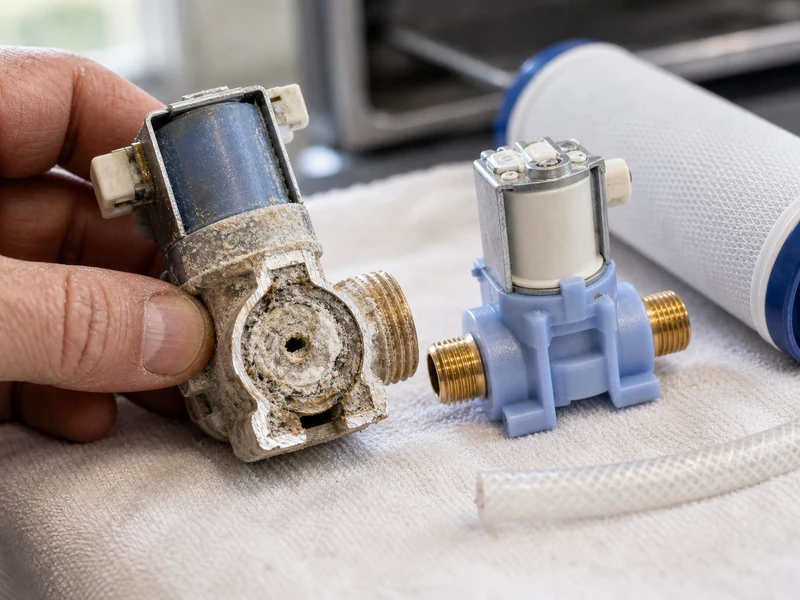
Jacksonville draws its water from the Floridan aquifer, a vast limestone formation, and the mineral comes along for the ride. Inside a Sub-Zero® ice maker that mineral settles wherever water slows or stops: the inlet valve’s orifice, the fill tube’s elbow, the mold’s floor. The valve is the first casualty — its opening narrows year by year until a harvest that once took minutes takes an evening, and then stops.

Electrical wear runs a close second. The solenoid that drives the fill valve cycles thousands of times a year, and on the Classic BI generation it is a known wear item with a fairly predictable lifespan. The older 600-series boards even police this themselves, logging a fault whenever a solenoid stays energized beyond fifteen seconds — a code worth reading before anyone swaps parts.

The houses add their own variable. The 1920s blocks around the Square still carry original galley plumbing in places, and a water line with tired pressure starves an ice maker as surely as a scaled valve. We test flow at the unit before condemning anything inside it.

Cross-section of a Sub-Zero water inlet valve narrowed by limestone scale from Jacksonville JEA water

The Ledger

Symptom, First Check, and Likely Outlay

Symptom First check Likely outlay
Cubes shrinking over months Inlet valve flow rate and filter age $250–$450
No ice at all, arrived overnight Solenoid and its circuit, then the module itself $300–$650
Hollow or cloudy cubes Fill volume against spec — a starving line underfills the mold $250–$450
Ice tastes stale or off Filter cartridge, bin hygiene, and line condition in that order $250–$350
Water on the freezer floor below the maker Fill tube icing and overshoot — often scale forcing a misaimed fill $300–$550

Matters of Record

Three Facts Worth Keeping About Ice and This City

JEA water hardness runs 14–28 grains per gallon

That places the whole service area in the “very hard” classification — among the hardest municipal water in Florida — and makes mineral scale the leading cause of ice maker failure in San Marco rather than mechanical wear.

A water filter here earns replacement every six months

The manufacturer’s annual guidance assumes gentler water than ours. On 32207’s supply, a cartridge at month nine is a flow restriction wearing a filter’s label, and restricted flow is what kills valves.

Most San Marco ice maker repairs settle between $250 and $650

Descaling and filters anchor the low end; a complete ice maker assembly defines the high end. Anything beyond that range means the fault has left the ice maker and entered the refrigeration system proper.

The Visit

What a Tech Checks Before Touching a Part

  1. Test water flow and pressure at the unit’s supply valve — a starving galley line in a 1920s kitchen mimics a scaled ice maker exactly, and condemning the wrong one wastes a part.
  2. Check the filter date and condition; on 32207’s 14–28 grain water a cartridge past six months is a flow restriction wearing a filter’s label.
  3. Inspect the inlet valve orifice and solenoid for the limestone crust that narrows fill year by year, and read the harvest cycle’s timing.
  4. On 600-series boards, pull the fault log for the solenoid-energized-too-long code before assuming mechanical failure.
  5. Measure fill volume against the model spec, then descale or replace — and tell you which side of that line your valve falls on before any work begins.

The order matters because most San Marco ice calls are water-path problems masquerading as mechanical ones. When the fault truly is electrical, it points to the Classic BI solenoid rather than scale, and the pattern of failure — gradual versus overnight — usually names it before a meter does.

Prevention

A Hard-Water Maintenance Calendar for 32207

The cheapest ice maker repair is the one the water never gets to cause. Against JEA’s limestone supply, a short routine extends valve and module life measurably between visits.

Interval The task What it prevents
Every 6 months Replace the water filter — half the manufacturer’s annual interval, set for our hardness Restricted flow that starves the mold and strains the inlet valve
Every 6–12 months Clean the condenser coil with a vacuum and brush Excessive run that overheats the cabinet and shortens every component’s life
Yearly Empty and wash the ice bin; discard ice older than a few weeks Stale, odor-absorbing cubes mistaken for a water-quality fault
At any taste or flow change Time one harvest cycle and check the filter date before calling A wasted visit — the number often names the part over the phone

The Households

Ice for Houses That Entertain

Between River Road and the gates of Epping Forest, ice is infrastructure. The estates that host yacht-club season and Bolles gatherings often run the main unit’s ice maker alongside dedicated machines, and a failure ahead of a weekend is treated, properly, as urgent. We hold our paperwork current with the gatehouses — the details are in our note on serving Epping Forest and San Jose — so access rarely delays a visit.

Owners of the 700 Series integrated units should know their fill systems are a documented weak point as the units age, and that an ice maker mounted inside a freezer with a defrost fault will fail in sympathy long before its own time. Ring the workshop at (904) 893-3248, or use the online appointment page, and describe what the ice has been doing — the pattern usually names the part.

Arrange a Visit from the Workshop

Weekday appointments across San Marco, San Jose, and Epping Forest — gate clearance arranged before we arrive.

(904) 893-3248 · Monday–Friday, 7:30 am – 5:30 pm

Correspondence

Ice Maker Questions from 32207

Why did my Sub-Zero ice maker slow down for months before stopping entirely?

That long decline is the signature of scale. Jacksonville’s water deposits limestone inside the inlet valve and fill tube a little at a time, so each harvest gets slightly smaller and slower until the valve no longer passes enough water to form a tray. A failure that arrives gradually almost always lives in the water path; failures that arrive overnight are usually electrical.

Does hard water genuinely ruin ice maker valves, or is that a sales line?

It is chemistry, not salesmanship. JEA water is drawn from the limestone Floridan aquifer and measures 14 to 28 grains per gallon — firmly in the “very hard” classification. Every gallon leaves a film of mineral behind, and the inlet valve’s small orifice is the first place that film matters. We replace far more scaled valves in 32207 than worn motors.

Why does fresh ice pick up stale or pantry-like flavors?

Ice is a sponge for whatever the cabinet holds. An overdue water filter is the first suspect; an open container of leftovers the second; a bin of elderly ice the third, since cubes left for weeks absorb odors steadily. Replace the filter, empty and wash the bin, and let a full new harvest come through. If the taste persists, the water line itself deserves inspection.

Is descaling worthwhile, or should the parts simply be replaced?

Both have their place, and honesty decides which. A fill tube or ice mold with light mineral film responds well to descaling. An inlet valve does not — once its orifice and solenoid seat are crusted, cleaning is a temporary courtesy at best, and we would rather fit a new valve than charge twice for the same symptom. We tell you which side of that line your unit is on before work begins.

What does ice maker work usually cost around the Square?

Most calls in San Marco and San Jose settle between $250 and $650. A filter and descaling service sits at the bottom of that range, a new inlet valve in the middle, and a complete ice maker assembly at the top. The 600-series units add one wrinkle — a solenoid fault their boards log when energized too long — which is why we read the unit’s history before replacing anything.

Will a whole-house water softener stop my Sub-Zero ice maker from scaling?

It helps considerably, because softened water carries far less of the calcium and magnesium that crusts an inlet valve shut. The caveat is taste: many owners route the kitchen cold line and the ice maker around the softener to keep the brine flavor out, which leaves the ice maker drinking the full 14–28 grains again. A dedicated carbon-and-scale filter on the ice maker line is often the better answer, and we are glad to advise on the setup during a visit.

How long should a Sub-Zero take to refill its bin after I empty it?

A healthy unit makes roughly a full harvest every 90 minutes to two hours and refills a standard bin within a day. If yours takes two or three days, the supply is restricted — a scaled valve, an overdue filter, or a tired galley water line in an older San Marco kitchen. Time one harvest cycle before you call; that single number tells us whether to look at the water path or the harvest mechanism.

Do the cubes coming out hollow or small mean the ice maker is dying?

Rarely dying — usually underfed. Hollow shells and undersized cubes mean the mold is not receiving its full charge of water, which on 32207’s supply almost always traces to a partly scaled valve or a starving line rather than a failed harvest motor. We measure fill volume against the model’s spec before condemning anything; restoring proper flow brings the cube back to full size far more often than a new module does.