Skip to content

San Marco · Jacksonville, Florida 32207

Monday–Friday, 7:30 am – 5:30 pm

(904) 893-3248
Sub-Zero Service San Marco
Menu

Repairs · Refrigerator

Sub-Zero Refrigerator Repair in San Marco

The quiet failures of a built-in refrigerator, read correctly the first time — in kitchens where the cabinetry is older than the appliance.

Sub-Zero Service San Marco repairs built-in Sub-Zero refrigerators across San Marco, San Jose, and Epping Forest — ZIP codes 32207 and 32217. The common faults — drifted thermistors, stalled evaporator fans, surge-damaged control boards — land between $250 and $1,100, diagnosed in a single weekday visit.

For Sub-Zero repair across San Marco and the river streets, ring the workshop at (904) 893-3248 or book online.

Entry revised 13 June 2026

(904) 893-3248 · Monday–Friday, 7:30 am – 5:30 pm

The Usual Suspects

What Fails First on a Built-In Refrigerator?

A Sub-Zero® is engineered around one number: 38°F in the refrigerator, held without drama for decades. When that number slips, the cause is usually peripheral rather than fundamental. The thermistor — the small sensor that tells the board what the cabinet is doing — drifts with age and begins reporting temperatures that no longer exist.

The evaporator fan is the second suspect, particularly on the 600 generation, where its failure produces the classic complaint of a freezer working perfectly above a refrigerator going soft. Third is the condenser: a year of household dust is enough to make the system labor, run long, and eventually log the excessive-run faults we cover in our note on reading Sub-Zero error codes.

Control boards deserve their own paragraph in this neighborhood. Jacksonville endures more than a hundred thunderstorm days a year, and the voltage spike that arrives when power is restored is a documented board killer — the reason so many units here come back warm after an outage. Sub-Zero Service San Marco services these refrigerators throughout 32207 and 32217; the workshop line is (904) 893-3248, and appointments can be requested through our online booking page.

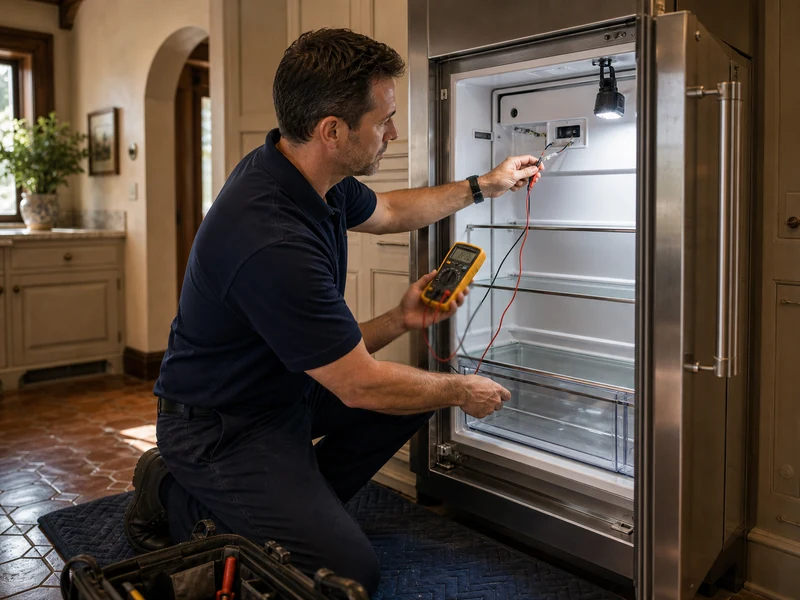
Technician taking thermistor resistance readings inside a built-in Sub-Zero refrigerator in a restored San Marco kitchen

The Ledger

Complaint, First Inspection, and Cost Lane

Working ranges from our own invoices — never quotes, because a quote without a diagnosis is a guess wearing a suit.

The complaint Where we look first Cost lane
Refrigerator drifting into the mid-40s Thermistor resistance against spec, then condenser condition $250–$550
Freezer cold, refrigerator soft Evaporator fan motor and its circuit — the 600-series signature $300–$700
Runs long, never satisfied, EC code logged Condenser airflow and door gasket seal before any part is named $250–$1,100
Display dark or showing dashes Control board and EEPROM, with surge history taken into account $550–$1,100
Frost confined to one corner of the evaporator Refrigerant pressure — the signature of a sealed-system leak $1,500–$3,000

The Houses

How San Marco’s Architecture Shapes the Repair

The blocks around Granada and the Square were laid out in the 1920s, and their kitchens still carry the period’s proportions — galley runs, plaster returns, butler’s pantries built for staff rather than appliances. A forty-two-inch built-in often sits in an alcove cut for it during a 1990s remodel, flanked by original casework. We measure twice, pad everything, and bring the unit forward on rollers rather than dragging it across heart-pine floors.

The river adds its own chapter. Kitchens along River Road and the Southbank that took Irma’s 2017 surge can harbor corrosion that creeps along board traces for years before the first symptom — a history we documented in the journal’s storm entry. And the larger riverfront estates rarely keep one unit; a single kitchen may hold a column pair from the Designer and Integrated line beside an older workhorse, each sealed system aging on its own schedule.

The Visit

What Happens During a Diagnostic Call?

  1. Confirm the setpoints — 38°F refrigerator, 0°F freezer — and record what the cabinet is actually holding against them.
  2. Pull the grille and inspect the condenser; a choked coil explains more warm refrigerators than any electronic component.
  3. Read thermistor resistance against the service spec, then verify the evaporator fan runs under load.
  4. Read the frost pattern on the evaporator itself — full and even is healthy; a partial patch points into the sealed system.
  5. Review the board’s error history, written down before anything is cleared, and deliver a firm figure before any part is ordered.

If the trail leads to refrigerant, the conversation changes register and moves to our sealed system and compressor page — larger figures, stated plainly, with the evidence laid out first. If the unit is from the Classic BI generation of 2008–2022, we also check the condenser fan triac, a known casualty of this city’s storms.

The Parts Box

The Parts Replaced Most on the Fresh-Food Side

Five components account for the great majority of refrigerator-side repairs across the 500, 600, and BI generations — and each fails in a way the houses around the Square make worse.

Part Why it fails here Typical lane
Thermistor (temperature sensor) Resistance drifts with age; the board then cools to a number that no longer exists $250–$450
Evaporator fan motor Bearings dry and stall — the 600-series cause of a hard freezer over a soft refrigerator $300–$700
Condenser fan / fan triac on the board Triac fails on surge-struck BI boards; the fan stops and the system overheats $300–$900
Door gasket Riverfront humidity stiffens the seal, drawing in warm air and frosting the box $250–$550
Control board / EEPROM Storm surges corrupt the logic; a failed EEPROM shows dashes on the display $550–$1,100

The Judgment Call

When to Ring Us, and When You Can Safely Wait

Not every complaint warrants the same urgency, and an honest practice will say so. A handful of owner checks settle the question before the workshop line does — and a few symptoms mean the breaker and the recipe books should stay where they are.

  1. Safe to wait a day or two: the box reads 40–44°F, the condenser grille is visibly furred with dust, or a gasket has a small gap you can feel — clean the coil, check the seal, and book a routine window.
  2. Ring this week: the freezer is rock-hard while the refrigerator climbs past the mid-40s, or the compressor runs without ever shutting off — a fan or thermistor is failing and the system is laboring.
  3. Ring today and stop cycling the breaker: the display is dark or showing dashes after a storm, which is board territory, not a reset you can win by flipping power.
  4. Leave it to the bench, not a video: frost confined to one corner of the evaporator, a hissing or oily film near the coils, or a unit that pulls down then climbs in a daily cycle — these are sealed-system tells, and a refrigerant circuit is no place for do-it-yourself.

The reliable rule in 32207: gradual warming with a dirty coil is usually a chore; sudden warming, a dark panel, or a partial frost line is a call. When a warm box resists the simple checks, our not-cooling walk-through carries the full diagnostic order, and the workshop line is (904) 893-3248.

Arrange a Visit from the Workshop

Weekday appointments across San Marco, San Jose, and Epping Forest — gate clearance arranged before we arrive.

(904) 893-3248 · Monday–Friday, 7:30 am – 5:30 pm

Correspondence

Refrigerator Questions from the Bench

Why is my Sub-Zero running constantly but the refrigerator side stays warm?

Three suspects account for most of these calls: a condenser so laden with dust that the system cannot shed heat, a thermistor reporting fiction to the control board, or an evaporator fan that has quietly stopped circulating air. All three are afternoon repairs in the $250–$700 range. Only when those are ruled out do we begin discussing the sealed system itself.

What does a refrigerator repair visit cost in 32207?

The diagnostic visit carries a flat fee that we state when you book, and it is applied toward the repair if you proceed. The repairs themselves mostly fall between $250 and $1,100 — condenser service and fans at the lower end, control boards toward the upper. Anything involving refrigerant is quoted separately, in writing, before a gauge ever touches the unit.

Do you keep parts for refrigerators built before 2000?

We stock the recurring consumables — thermistors, fan motors, gaskets, relays — for the 500 and 600 generations that still serve many older San Marco and San Jose kitchens. Some original control boards are now rebuilt rather than bought new, and we say so up front, because a rebuilt board carries different expectations than a sealed factory box.

Can you service a panel-ready unit without disturbing original cabinetry?

Yes, and it is much of why we exist. The overlay panels in a Mediterranean Revival kitchen often predate the appliance and cannot be reordered from anyone. We remove and rehang panels with their hinges indexed, protect the surrounding casework, and treat the millwork as the irreplaceable element in the room — because in these houses, it is.

My Sub-Zero refrigerator is in the mid-40s — is that an emergency the same day?

A box drifting into the low- to mid-40s is urgent but not a midnight crisis. Foods at 40°F or below remain in the safe zone, so move the most perishable items to the freezer or a working unit and book the earliest weekday window. What separates a cheap repair from an expensive one here is acting before the compressor short-cycles itself toward sealed-system damage, not before sunset. Ring the workshop and describe the cabinet temperature; that number alone tells us how to triage your visit.

How do I tell a failing condenser fan from a failing evaporator fan?

Listen to where the air stops. The condenser fan lives behind the lower grille and runs whenever the compressor does; if the grille area is dead silent and hot, that fan has stalled. The evaporator fan is inside the cabinet behind the rear panel and moves cold air into the fresh-food space; when it quits, the freezer stays hard while the refrigerator goes soft — the 600-series signature. Both are sub-$700 motor jobs, but the cure starts with identifying which fan went quiet.

After a board replacement, why does the refrigerator take a full day to recover?

A Sub-Zero needs roughly 24 hours to settle at 38°F refrigerator and 0°F freezer after any interruption to its control logic, and a new board is exactly that. The system pulls down deliberately to avoid icing the evaporator, then learns its defrost rhythm over the first cycles. Judge the repair the next day, not the next hour — a box that is steadily falling toward set point is working as designed.