Skip to content

San Marco · Jacksonville, Florida 32207

Monday–Friday, 7:30 am – 5:30 pm

(904) 893-3248
Sub-Zero Service San Marco
Menu

Repairs · Freezer

Sub-Zero Freezer Repair for San Marco Kitchens

Ice where it should not be, and none where it should — the two complaints that bring us to freezers from Granada to Epping Forest.

We repair Sub-Zero freezers and freezer drawers throughout San Marco and San Jose, ZIP codes 32207 and 32217. Most failures trace to the defrost system — a dead heater, a tired thermostat, a silted drain — and resolve between $300 and $1,100, with the diagnosis delivered before any part is ordered.

For Sub-Zero repair across San Marco and the river streets, ring the workshop at (904) 893-3248 or book online.

Notes current as of 13 June 2026

(904) 893-3248 · Monday–Friday, 7:30 am – 5:30 pm

The Mechanism

Why Do Sub-Zero Freezers Ice Over?

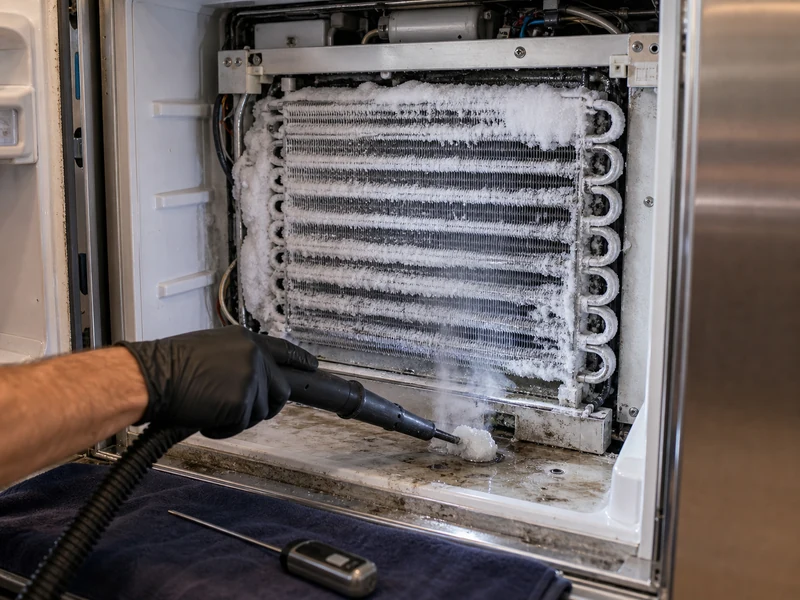
A Sub-Zero® freezer holds 0°F by running frost through a disciplined cycle: the evaporator gathers it, the defrost heater melts it on schedule, and the meltwater leaves through a drain hardly wider than a pencil. The discipline is the vulnerability. When the heater or its thermostat fails, frost compounds daily until the coil suffocates under ice and the compartment warms despite a compressor running flat out.

When the drain silts shut instead — and a unit from the 1990s has run five thousand defrost cycles or more — the water refreezes as a sheet beneath the baskets and eventually escapes as a leak. Either path can end with an EC40 logged on the display, the freezer-side excessive-run fault we unpack in the error-code ledger.

Humidity is the third party in every Jacksonville freezer complaint. A gasket that has stiffened after years of riverfront air lets moisture in with every door swing, and no defrost system was sized for that. It is why we read the seal before we condemn a single component.

Iced-over evaporator coil and defrost drain inside a Sub-Zero freezer compartment in a Granada kitchen

The Ledger

What You See, What It Means, What It Runs

Observation Probable mechanism Working range
Ice sheet under the baskets, water at the toe-kick Defrost drain silted shut after years of cycles $300–$450
Thick frost on the back wall, even and spreading Defrost heater or thermostat open — frost never clears $450–$800
Frost concentrated near the door frame Gasket no longer sealing against humid room air $300–$600
EC40 on the display, compartment slow to recover Excessive freezer compressor run — airflow or seal, occasionally deeper $300–$1,100
Compressor hot, freezer warm, frost only partial on the coil Refrigerant loss — the sealed system, quoted only on evidence $1,500–$3,000

Case Notes

A Freezer Drawer in Granada, Read from the Frost

Educational diagnostic scenario

Picture a 2012 built-in with freezer drawers in a Granada bungalow remodeled around its original casework. The complaint: soft ice cream and a drawer that grinds on its slides. The frost tells the story before a meter comes out — an even white coat across the whole evaporator means the sealed system is healthy, so attention turns to the defrost circuit. The heater reads open; the thermostat gets replaced alongside it as a matter of course.

The grinding drawer is the same job on a different scale — worn slides carrying more weight than the owners realize, a wear pattern we see constantly on the 700 Series drawer units built from 1994 to 2013. One visit, two repairs, both inside the moderate cost lane. The lesson worth keeping: frost pattern first, parts second.

The Defrost Circuit

The Defrost System, Part by Part

Most freezer faults in 32207 live inside one small system. Knowing its four parts — and which one a symptom implicates — turns a frightening freezer-down morning into a predictable repair.

Component Its job How its failure shows
Defrost heater Melts frost off the evaporator on a timed cycle Even, spreading ice over the whole back wall; compartment slowly warms
Defrost thermostat Tells the heater when the coil is cold enough to need it Heater never fires; identical icing, diagnosed by a continuity test
Defrost drain Carries meltwater out of the compartment Ice sheet under the baskets, water at the toe-kick after thousands of cycles
Evaporator fan Pushes the cold air the coil makes through the compartment Growling that becomes silence; the freezer warms within hours of a seizure

The Visit

What a Tech Does on a Freezer-Down Call

  1. Read what the compartment is actually holding against 0°F, and confirm the reading with an independent thermometer rather than the door display alone.
  2. Open the compartment and read the frost: an even white coat across the evaporator means defrost or airflow; a patch only a few inches wide means refrigerant.
  3. Test the defrost heater and thermostat for continuity, and inspect the drain for the silted-shut blockage common on units past their five-thousandth cycle.
  4. Verify the evaporator fan runs under load and the door gasket still seals against humid riverfront air — the seal is checked before any component is condemned.
  5. Pull the freezer error history, note any EC40 logged, and deliver a firm figure before a single part is ordered.

When that order ends at refrigerant rather than defrost, the work moves to the sealed-system bench with the frost pattern photographed first. On drawer units, the same call often turns up the worn slides we describe on the 700 Series page — one visit, two repairs.

The Neighborhood

Freezers That Work Harder South of the Square

The entertaining culture of the riverfront estates — yacht-club seasons, Bolles events, holidays that fill every appliance in the house — means the freezers here are loaded deep and opened often. Many homes between River Road and Epping Forest run a dedicated all-freezer column beside the main unit, and when one of a pair fails the other masks it for weeks.

We service both halves of that arrangement, along with the ice makers that live inside them and inevitably age faster than the cabinets around them. And when a freezer’s trouble turns out to be refrigerant rather than defrost, the work moves to the sealed-system bench — with the evidence photographed and explained before any figure is spoken. The workshop line is (904) 893-3248 for either conversation.

Arrange a Visit from the Workshop

Weekday appointments across San Marco, San Jose, and Epping Forest — gate clearance arranged before we arrive.

(904) 893-3248 · Monday–Friday, 7:30 am – 5:30 pm

Correspondence

Freezer Questions, Answered Plainly

Why does frost keep returning to the back wall of my Sub-Zero freezer?

Recurring frost means moist air is getting in or the defrost system is not clearing what accumulates. A hardened gasket is the humble cause — Florida’s humid air finds every gap. The mechanical cause is a defrost heater or thermostat that has quietly died, letting each day’s frost build on the last until the coil is a block of ice. Both are measurable on the spot.

What does a sheet of ice beneath the freezer basket mean?

Almost always a clogged defrost drain. Each defrost cycle melts frost off the coil and sends the water down a small drain; an older unit has run that cycle thousands of times, and the drain eventually silts shut. The meltwater then refreezes on the floor of the compartment, sheet upon sheet. Clearing and treating the drain is among the least expensive repairs we perform.

How long will food hold if the freezer fails before your visit?

Longer than most owners fear. A loaded Sub-Zero freezer with the door kept shut typically holds safe temperatures for a day or more, because the frozen mass acts as its own thermal ballast. Keep the door closed, resist inspecting hourly, and tell us when you ring — a freezer-down call is the kind we work hardest to fit into the earliest weekday window.

Is a noisy freezer fan worth repairing, or a sign of worse coming?

Worth repairing, and promptly. An evaporator fan that has begun to growl is announcing bearing wear; when it finally seizes, the compartment loses circulation and temperatures climb within hours. Caught early it is a straightforward motor replacement in the $300–$700 lane. Ignored, it can masquerade as a far more serious cooling failure and spoil a full freezer in the meantime.

My freezer holds 10°F instead of 0°F — does that small gap actually matter?

It matters more than it looks. At 0°F ice cream stays scoopable-firm and long-term storage is genuinely long-term; at 10°F the same freezer ages food faster, builds soft frost, and signals that something — airflow, defrost timing, or a tiring seal — is no longer keeping pace. A 10-degree miss is the early warning we would rather answer than the eventual total failure. Confirm the reading with a separate thermometer, then book a window before the gap widens.

Can a clogged defrost drain really flood the kitchen floor?

It can, and in San Marco’s heart-pine kitchens that is the expensive part. When the drain silts shut, each defrost cycle’s meltwater has nowhere to go; it first sheets across the compartment floor, then overruns the toe-kick and reaches the flooring. We clear and treat the drain, but on older homes we also check whether prior overflows have reached the subfloor — a conversation worth having before water becomes a second repair.

Why does my freezer run constantly yet never reach 0°F?

A compressor running without rest while the compartment stays warm points to either restricted airflow or a sealed-system loss, and the frost pattern tells us which. An even white coat on the evaporator with poor air movement means a stalled fan or an iced coil from a defrost fault. A coil frosted only a few inches in means refrigerant has escaped. We read that pattern first, because it decides whether the repair lives in the $300–$1,100 lane or moves to the sealed system.