Skip to content

San Marco · Jacksonville, Florida 32207

Monday–Friday, 7:30 am – 5:30 pm

(904) 893-3248
Sub-Zero Service San Marco
Menu

Repairs · Wine Storage

Sub-Zero Wine Storage Repair for Riverfront San Marco

A cellar fails differently than a kitchen — slowly, silently, and at the expense of things that cannot be reordered.

We repair Sub-Zero wine storage across San Marco’s riverfront homes and the estates of 32207 and 32217 — the 424 and 427 cabinets of 1999–2016, the later IW and BW units, and current wine columns. Drifting zones, iced evaporators, and swollen door seals typically resolve between $250 and $900.

For Sub-Zero repair across San Marco and the river streets, ring the workshop at (904) 893-3248 or book online.

Entry kept current — 13 June 2026

(904) 893-3248 · Monday–Friday, 7:30 am – 5:30 pm

The Climate Problem

Why Florida Is Hard on Wine Refrigeration

A Sub-Zero® wine unit is asked to hold two climates at once — separate zones a cellar’s width apart in temperature — inside a state that supplies a third climate for free. Jacksonville’s humidity works on these cabinets year-round: evaporators gather frost faster than their defrost schedule anticipates, condensate outpaces its drainage, and door seals swell in rooms the air conditioning never quite reaches.

The electronics feel the strain second. Dual-zone control depends on thermistors that drift with age, and a drifted sensor makes a healthy compressor chase a phantom. We test sensors against a reference before touching refrigerant — most “failing” wine cabinets in this neighborhood need a forty-dollar sensor and an honest hour, not sealed-system surgery.

When the fault is mechanical, vintage matters. The 400 Series cabinets — the 424s and 427s that anchor most established wine rooms here — left production years ago, and we are candid about which parts remain plentiful and which now require patience.

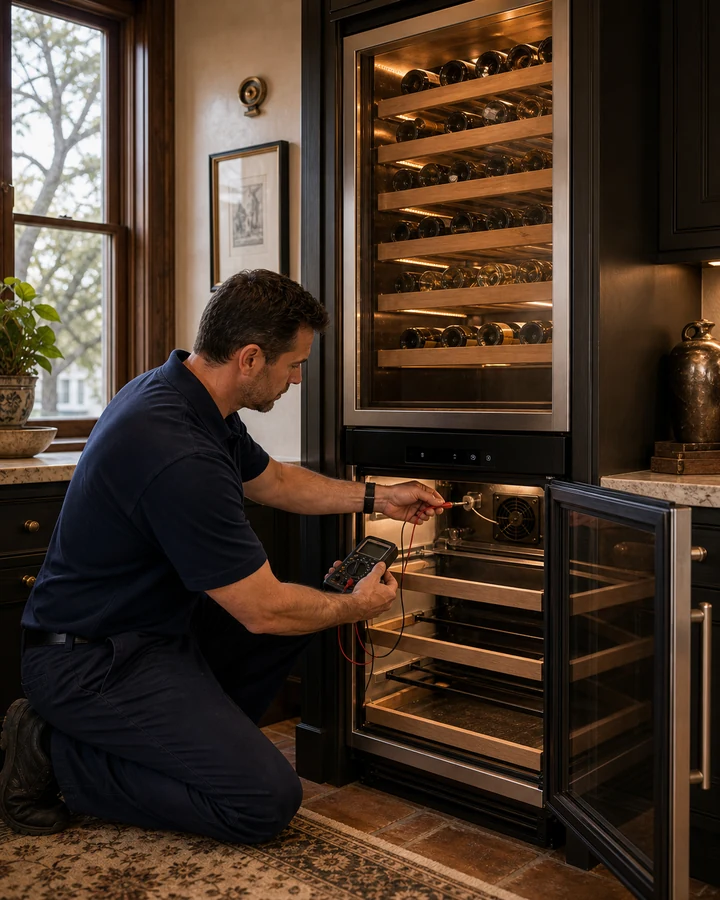
Sub-Zero 427 dual-zone wine cabinet with the lower zone opened for thermistor testing in a San Marco butler's pantry

The Ledger

Trouble, Origin, and the Figure It Carries

The trouble Where it usually starts Working figure
Zones reading several degrees apart Thermistor drift in one zone’s sensor $250–$450
Cabinet warming through the day, recovering at night Evaporator icing — defrost or airflow, aggravated by humidity $350–$700
Water beneath or behind the unit Condensate drain or pan overwhelmed in an unconditioned room $250–$500
Door seal visibly proud or torn at a corner Gasket swelling — Florida’s standing complaint against glass doors $300–$600
Compressor running without pause, both zones warm Refrigerant loss or condenser failure — evidence before estimate $700–$2,000

The Visit

How a Wine Cabinet Is Diagnosed in Place

  1. Place an independent thermometer in each zone and compare it to the display — drift between the two readings, not the display alone, reveals a wandering thermistor.
  2. Read the evaporator for icing and the condensate pan for overflow, the two faults Florida humidity drives hardest in unconditioned pantries.
  3. Inspect the door seal and, on glass doors, the edge-heater circuit that fights summer dew point on the pane.
  4. Test both zone sensors against a calibrated reference before any refrigerant gauge comes out, because a forty-dollar sensor explains most "failing" cabinets here.
  5. Only with airflow, sensors, and seal cleared does the conversation move to the sealed system — and then with the evidence shown first.

The discipline saves owners real money: a drifted sensor and a healthy compressor produce identical symptoms, and only a methodical read tells them apart. The 424 and 427 cabinets that anchor most local cellars respond especially well to this order — their detail sits on the 400 Series page.

The Room Itself

Where a Wine Cabinet Lives Decides How Often It Fails

A cabinet rated for a conditioned room behaves very differently depending on where San Marco’s houses actually put it. Placement is half the diagnosis.

Where it lives The strain it adds Service implication
Conditioned wine room or kitchen Minimal — the cabinet works within its design envelope Sensor and seal service on a normal aging curve
Converted butler’s pantry, partly conditioned Summer humidity bleeds in; evaporator ices sooner More frequent defrost and condensate attention
Unconditioned garage or summer kitchen Full Florida humidity and heat year-round Shorter seal life, recurring icing — relocation worth weighing
Riverfront room that flooded under Irma Latent board and connector corrosion from 2017 Electronics checked first, per the storm journal

The Cellars

Wine Rooms from River Road to Epping Forest

The riverfront estates between the Square and Epping Forest take their cellars seriously — purpose-built wine rooms behind the dining room, a 427 standing in the original butler’s pantry, wine drawers worked into a kitchen island. Several of these rooms sit in houses that took water when Irma pushed the river over its banks in 2017, and the equipment that survived carries that history in its wiring — a subject the journal treats at length.

We service the standing cabinets alongside the flush wine columns of the Designer era, whose panel-and-hinge fit makes amateur repair an expensive hobby. The workshop line is (904) 893-3248; describe the cabinet, the room it lives in, and what the two zones are reading, and we will tell you honestly whether it warrants a visit.

Arrange a Visit from the Workshop

Weekday appointments across San Marco, San Jose, and Epping Forest — gate clearance arranged before we arrive.

(904) 893-3248 · Monday–Friday, 7:30 am – 5:30 pm

Correspondence

Questions from the Wine Rooms

Why are the two zones of my wine cabinet drifting apart in temperature?

Each zone trusts its own thermistor, and thermistors age at their own pace. When one begins reading a degree or two of fiction, its zone compensates for a problem that does not exist, and the spread between upper and lower racks widens season by season. The repair is unglamorous and effective: test both sensors against a calibrated reference and replace the one that has wandered.

Can a wine unit survive in an unconditioned butler’s pantry here?

It can, but it pays a tax. A cabinet rated for a conditioned room works against Jacksonville’s humidity all summer when it lives in a pantry or garage that never sees the air conditioner. Evaporators ice sooner, condensate pans overflow, and seals swell. We service plenty of units in exactly those rooms — we simply set maintenance expectations honestly: more frequent attention, shorter part lifespans.

My 427’s glass door sweats every August — fault or climate?

Mostly climate, partly fault. Glass shows the dew point the way painted steel never does, and an August afternoon in 32207 will fog any cold pane. But a door that streams rather than mists, or sweats in a conditioned room, points to a seal no longer meeting the frame or a heater circuit no longer warming the glass edge. The distinction takes minutes to test and is worth knowing.

How quickly should I act when a wine cabinet starts warming?

Faster than you would for a refrigerator, oddly enough. Food forgives a warm afternoon; a cellar’s value does not forgive a warm month, and slow drift is precisely how wine units fail — quietly, a degree at a time, while the bottles cook politely. If the display and a separate thermometer disagree, or the compressor has gone notably quiet or notably constant, ring us that week.

What temperature and humidity should a Sub-Zero wine cabinet actually hold?

A single-zone unit is happiest near 55°F; a dual-zone cabinet typically runs the lower rack around 50–55°F for reds and the upper closer to 45°F for whites and sparkling. Sub-Zero’s own active-humidity design aims to keep corks supple, so a reading drifting toward dry air is itself a symptom. When the spread between your two zones widens past a couple of degrees from those targets, a thermistor is the usual culprit — not the refrigeration.

My wine cabinet vibrates and I worry it is disturbing the bottles — is that normal?

A faint hum from the compressor is normal and harmless to wine; a new rattle or buzz is not, and it usually traces to a condenser fan with worn bearings or a loose component rather than the sealed system. Vibration matters less to the bottles than owners fear, but a fan announcing wear should be addressed before it seizes and the cabinet warms. We isolate the source by ear and touch before opening anything.

Can you relocate a built-in wine cabinet from a garage into a conditioned room?

We can advise on it, though the move itself is a cabinetry and electrical job we coordinate rather than perform alone. The case for moving is real: a unit run in an unconditioned San Marco garage or summer kitchen fights Florida humidity all year, ices its evaporator sooner, and burns through seals. If the cabinet is sound, relocating it to conditioned space often pays for itself in deferred repairs — and we will tell you honestly whether yours is worth the trouble.