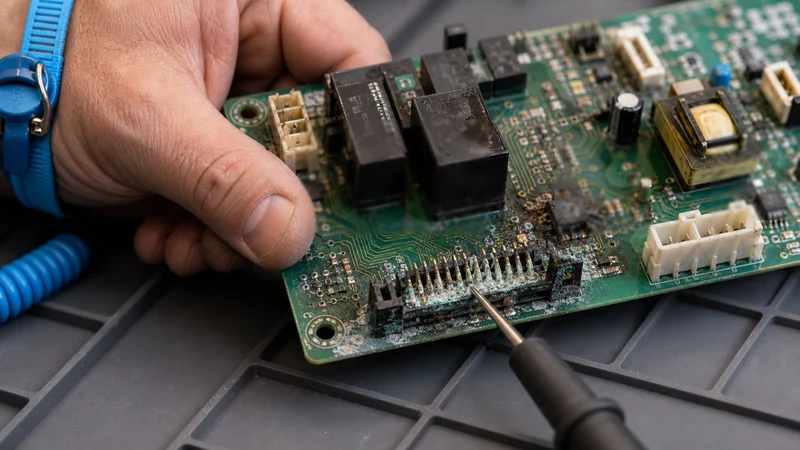
My BI-36U has its interior lights on but the control panel is completely dark — what is that?
That precise combination — lights working, display dead — is the brownout-lock signature of the Classic BI control board. A sag or surge during a power event, most often the spike when service is restored, corrupts the board’s logic and it refuses to wake. Stop cycling the breaker, which can compound the damage, and have the board diagnosed. It is among the most common BI faults we answer in 32207.
Why does Jacksonville produce so many failed BI control boards?
Geography and weather. No region in the country draws more cloud-to-ground lightning than this stretch of the First Coast, where storm days run past a hundred each year, and the voltage spike that rides in when JEA restores power can reach fifty to a hundred percent over nominal. The Classic BI board has no factory tolerance for that, which is why we routinely recommend whole-home surge protection alongside the repair.
How do I read my BI model number, and does it change the repair?
The tag sits inside the fresh-food compartment, usually on the upper left wall, and reads BI-36, BI-42, or BI-48 followed by a letter for the configuration — U for upright french-door, S for side-by-side, with D, FD, or O suffixes for variants. It matters because board revisions and ice systems differ across the range; a BI-42SD does not share every part with a BI-48S, so we confirm the exact tag before ordering.
Is the BI series still in production, and can it still be serviced?
Production ended in 2022 when the new Classic CL line replaced it, but service support is healthy. The BI cabinets ran from 2008, so the installed base in San Marco is large and the common parts — boards, valves, gaskets, fan triacs, defrost components — remain available. We keep the recurring wear items on the truck and source board revisions to the unit’s serial range when a board is the culprit.
The ice maker on my BI-42 quit without warning — scale or electronics?
On a BI cabinet, an overnight stop usually points to the inlet valve solenoid, a known wear item on this generation, rather than the gradual choke that hard water produces. A scale failure declines over months; an electrical one arrives suddenly. We test the solenoid and its circuit first, check the board for the energized-too-long fault, and only then consider the water path. The pattern of failure names the part.
Should I add surge protection after a BI board repair?
We recommend it without hesitation here. A whole-home surge protector runs roughly $900 to $1,200 installed and is cheap insurance against the next storm taking the new board the same way it took the old one. For a BI cabinet that has already failed once to a power event, declining the protection is gambling against Jacksonville’s most reliable weather. We are glad to point you toward the right electrician.
How do I tell an EC50 caused by a dirty condenser from one caused by a real fault?
Start with the coil. EC50 means the refrigerator side has run excessively, and nine times out of ten the cause is airflow — a condenser furred with dust or a gasket no longer sealing. Clean the coil thoroughly, confirm the door seals, and watch whether the code returns over a day or two. If it clears, it was housekeeping. If it returns on a clean coil with a good gasket, the fault is deeper — a fan, a thermistor, or occasionally the sealed system — and that is the visit worth booking.
Is repairing a fifteen-year-old BI-48 worth it against the cost of a new one?
Usually, yes, and the cabinet drives the decision. A board, a valve, or a fan triac on a BI-48 lands in the hundreds to low thousands; a comparable new 48-inch built-in plus the install work runs many times that, and in a panel-ready San Marco kitchen the cabinetry alterations alone can rival the appliance. A BI cabinet from the late 2000s with one failed system and sound refrigeration has real life left — we reserve the replace advice for units failing on several fronts at once.
My BI-36UFD french-door unit ices at the back wall — is that the same as the side-by-sides?
The symptom is the same, the access differs. A back-wall ice build on any BI configuration points to the defrost circuit or a tired gasket letting humid air in, regardless of whether the doors are french, side-by-side, or over-under. The french-door UFD layout simply changes how we reach the evaporator and how the seal is inspected. We diagnose the defrost heater and thermostat the same way, then read the gasket, before anything is replaced.