Skip to content

San Marco · Jacksonville, Florida 32207

Monday–Friday, 7:30 am – 5:30 pm

(904) 893-3248
Sub-Zero Service San Marco
Menu

Neighborhoods

Sub-Zero Repair in Epping Forest and San Jose

The gated river enclave and the boulevard that leads to it — serviced on a standing weekday route, with the gatehouse already expecting us.

Sub-Zero Service San Marco services Epping Forest and San Jose, ZIP 32217, under standing gate arrangements — paperwork current with the gatehouse, weekday visits 7:30 to 5:30. The enclave's 1980s and '90s kitchens still run legacy Sub-Zero units, where most repairs land between $250 and $1,100.

For Sub-Zero repair across San Marco and the river streets, ring the workshop at (904) 893-3248 or book online.

(904) 893-3248 · Monday–Friday, 7:30 am – 5:30 pm

Behind the Gates

How Service Works at Epping Forest

Epping Forest grew out of Alfred I. duPont's 1920s riverfront estate, and the enclave keeps the formality of its origins: an attended gate, a yacht club calendar, and households that expect a tradesperson to arrive cleared, on time, and finished before the evening's entertaining. We built our access protocols around exactly that — clearance is arranged when the appointment is made, never negotiated at the gate.

The kitchens inside are serious ones. Estate houses from the 1980s and 1990s carry Sub-Zero® units from the legacy generations — over-unders and side-by-sides whose sealed systems are now decades into service — while renovated kitchens run flush integrated columns behind original-looking millwork. Both argue for repair over replacement: the cabinetry around them is the expensive part.

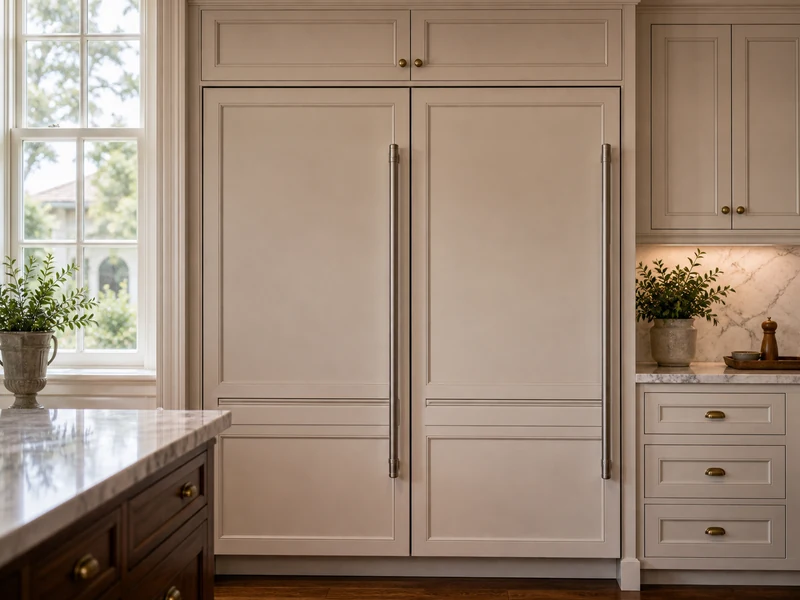
Paired Sub-Zero integrated columns in an Epping Forest estate kitchen with original millwork

The Corridor

San Jose, from the Boulevard to the River

San Jose Boulevard runs south past the Bolles School toward the country club, and the streets off it hold the corridor's quieter wealth — brick houses on deep lots, many built or remodeled in the decades when a 600-era Sub-Zero was the fixture of choice. Those units are in their sunset years now, and their owners face the neighborhood's recurring decision: a measured repair, or a replacement that takes the cabinetry with it.

Two local conditions shape the work. JEA water here runs 14 to 28 grains hard, which scales ice maker valves and filters on a schedule you can nearly set a clock by. And the oak canopy that makes these streets beautiful sheds pollen and debris that finds every condenser — we recommend the coil calendar to every household we visit. When a unit does drift warm, the diagnosis follows a fixed order rather than a guess.

The Map, in Brief

What We Find Where

Where you live What the kitchens typically hold The call we take most
Epping Forest estates Column pairs, drawer units, wine cabinets — several systems per house Zone failures and board work after storm season
San Jose Boulevard corridor Legacy over-unders and side-by-sides, decades in service Sealed-system evaluation and gasket renewal
River streets west of the boulevard Renovation-era built-ins, 10–20 years old Ice makers scaled by hard water; condenser care
Epping Forest condominiums Compact built-ins and undercounter units Gaskets and thermistors in tight alcove installs

Storm exposure reaches here as well — the enclave's mature trees and riverfront feeders make outages a yearly certainty, and our journal entry on surge damage explains what restoration spikes do to control boards.

Access, in Order

How a Gated Visit Is Arranged

The formality of the duPont-era enclave is a feature, not a friction, once the steps are known. This is the sequence we run for every Epping Forest call.

  1. Name the community and your address when you book; we match it against the gatehouse's current vendor protocol before the date is set.
  2. We supply the attended gate with the technician's name and the appointment window, so clearance is on file rather than negotiated at arrival.
  3. Where a residence sits behind a second association or a condominium front desk, we provide insurance and identification documentation ahead of time.
  4. The household confirms the appointment with the gate or its own calendar — often the only step a resident handles directly.
  5. We arrive within the weekday window, cleared, and spend the visit at the appliance rather than at the gate.
  6. If the yacht-club calendar or an entertaining date constrains the day, tell us when you book and we schedule around it.

The Enclave's Weather

Why Storm Season Reaches Hardest Inside the Gates

The mature canopy that makes Epping Forest beautiful is also what makes its power unreliable. The same oaks that shade the duPont-era drives drop limbs across riverfront feeders in every thunderstorm season, so outages here are a yearly certainty — and the restoration spikes that follow, commonly 50 to 100 percent over nominal, are the documented killer of Sub-Zero control boards. An enclave full of column pairs and wine cabinets carries a great deal of voltage-sensitive electronics behind its millwork.

The legacy units common in the 1980s and 1990s estate kitchens compound it. A board that has weathered three decades of these seasons is more fragile with each one, and on a 600-era unit a replacement may be a rebuilt exchange we source ahead. We recommend whole-home surge protection to every estate we visit and walk the reasoning through in our journal entry on storms and surges; when a unit does come back warm after an outage, the first-hour checklist keeps a marginal board from being finished off by a repeatedly cycled breaker.

Arrange a Visit from the Workshop

Weekday appointments across San Marco, San Jose, and Epping Forest — gate clearance arranged before we arrive.

(904) 893-3248 · Monday–Friday, 7:30 am – 5:30 pm

Correspondence

Asked from Behind the Gates

Do I need to arrange the Epping Forest gatehouse myself before a visit?

No — name the community when you book and we handle the rest. Our paperwork stays current with the gatehouse, so a resident typically only confirms the appointment with the front desk or their household calendar. If your building or association uses its own vendor list, we will supply whatever documentation it requires ahead of the visit.

Our San Jose house still runs its original 1990s Sub-Zero — can it be kept going?

Very often, yes. The corridor’s 1980s and 1990s houses carry units whose mechanical hearts were built to be serviced — compressors, fans, cold controls, gaskets, all replaceable. The honest caveat is parts: some legacy boards now exist only as rebuilt exchanges, so we confirm sourcing before promising anything. When a sealed-system repair runs $1,500–$3,000 against a five-figure integrated replacement, preservation usually wins.

How far down San Jose Boulevard does the service map run?

Through the 32217 stretch — from the St. Nicholas edge past the Bolles School campus to the Epping Forest gates, including the river streets west of the boulevard. Beyond that the map belongs to other shops; we keep ours small deliberately, because a short radius is what makes weekday scheduling and gate protocols dependable.

Does the Epping Forest condominium tower count, or only the estate houses?

Both. The enclave mixes river estates with condominium residences, and the compact built-ins and undercounter units in the towers face their own pattern — tight alcove installs that starve a condenser, and gaskets and thermistors worked hard by the close quarters. Building management often keeps a vendor list and a service-elevator protocol; name your residence when you book and we supply whatever documentation the front desk requires ahead of time.

Our San Jose house runs on an irrigation well for the yard — does that water ever reach the Sub-Zero?

Only if the ice maker is plumbed to it, which is rare but worth confirming. Most kitchens here draw JEA supply at 14 to 28 grains hard, and that scale is what clogs ice-maker inlet valves on a near-predictable calendar. A few older corridor houses tee the refrigerator off well water carrying iron or sulfur, which stains the ice and fouls the valve differently — we check the supply line at the first visit so the right fix follows the right water.

The estate has a generator — does that protect the Sub-Zero during the frequent outages out here?

Only if its output is clean and switched properly. The riverfront feeders and mature canopy make outages a yearly certainty in this enclave, but a generator feeding through anything other than a proper transfer switch can deliver dirtier voltage than the grid, and a Sub-Zero board does not distinguish a generator sag from a utility one. Pair the generator with whole-home surge protection, and the refrigeration is genuinely covered.