Skip to content

San Marco · Jacksonville, Florida 32207

Monday–Friday, 7:30 am – 5:30 pm

(904) 893-3248
Sub-Zero Service San Marco
Menu

The Journal

Storms, Surges, and Your Sub-Zero

Why Northeast Florida is harder on a Sub-Zero's electronics than on almost anything else in the kitchen — and what a careful owner can do about it.

In San Marco, the most common cause of a sudden Sub-Zero failure is not the outage but the surge that follows it — restoration spikes of 50 to 100 percent over nominal that destroy control boards. The 2017 Irma flood compounds it along River Road. Whole-home surge protection runs roughly $900–$1,200.

For Sub-Zero repair across San Marco and the river streets, ring the workshop at (904) 893-3248 or book online.

Updated June 13, 2026

(904) 893-3248 · Monday–Friday, 7:30 am – 5:30 pm

The Premise

Two Storms in Every San Marco Kitchen

Sub-Zero Service San Marco is an independent appliance practice working the historic riverfront blocks of San Marco, San Jose, and Epping Forest in Jacksonville, Florida 32207. We can be reached on the workshop line at (904) 893-3248, or through the external booking page listed on our appointments form. This entry is the long version of a conversation we have at almost every visit — because in this neighborhood, weather is the leading cause of refrigeration failure, and most of it is preventable.

A Sub-Zero® in San Marco lives through two kinds of storm. The first is the ordinary one: Northeast Florida endures more than a hundred thunderstorm days a year and leads the country in cloud-to-ground lightning, so outages and the restoration spikes behind them are a yearly certainty, not an exception. The second is the once-in-a-generation one — Irma, in September 2017, which pushed the St. Johns over its seawalls and into the low kitchens along River Road and the Southbank. Both leave their marks on a control board, and they leave them differently.

The houses here make the stakes high. These are 1920s Mediterranean Revival homes whose original wiring often predates the appliance by generations, feeding modern built-ins through panels that were never designed for them. When an integrated unit is set into irreplaceable 1920s millwork, the cheapest part of the kitchen is frequently the refrigeration — which is exactly why protecting it pays.

Matters of Record

The Numbers That Hold Up

Five facts we stand behind, each one drawn from the field rather than a brochure.

Restoration spikes run 50–100% over nominal

The damaging moment is rarely the outage — it is the half-second the feeder re-energizes, when voltage commonly overshoots by half again to double its normal value and lands straight on the control board.

Whole-home surge protection: about $900–$1,200 installed

A device at the service entrance is the only protection that reliably reaches a hard-wired built-in. It guards the wine cabinet, the range electronics, and everything else the panel feeds at the same time.

Brownout lock looks like lights-on, panel-dark

The interior lighting circuit survives while the logic side of the board sits blank. On the Classic BI generation built 2008–2022, that pairing is the single most recognizable storm injury.

Flood corrosion surfaces years after the water recedes

Brackish residue on connector pins oxidizes slowly. Boards from the 2017 River Road and Southbank flooding still fail in 2026, often during the next outage rather than the original one.

A surge-killed control board: roughly $550–$1,100

That is the replacement range across most BI and Designer units in the neighborhood. Sealed-system damage, where a surge reaches the compressor, runs higher — $1,000 to $3,000.

Anatomy of the Failure

How a Spike Becomes a Dead Refrigerator

A modern Sub-Zero is run by a microprocessor board that reads thermistors, commands the compressor and fans, and times the defrost cycle. That board is also the most voltage-sensitive component in the cabinet. When a restoration spike arrives, it tends to take the most exposed parts first — the condenser fan triac that switches the cooling fan, then the logic that drives the display.

The result is the brownout-lock pattern: the board latches into a protective state it cannot leave, or simply suffers a damaged trace, and the panel goes dark while the lights stay on. Owners often cycle the breaker hoping to reset it, but each re-energization is another small spike — and on a board already wounded, repetition finishes the job. The Classic BI units common in Granada and Colonial Manor remodels are the most frequent casualties we see.

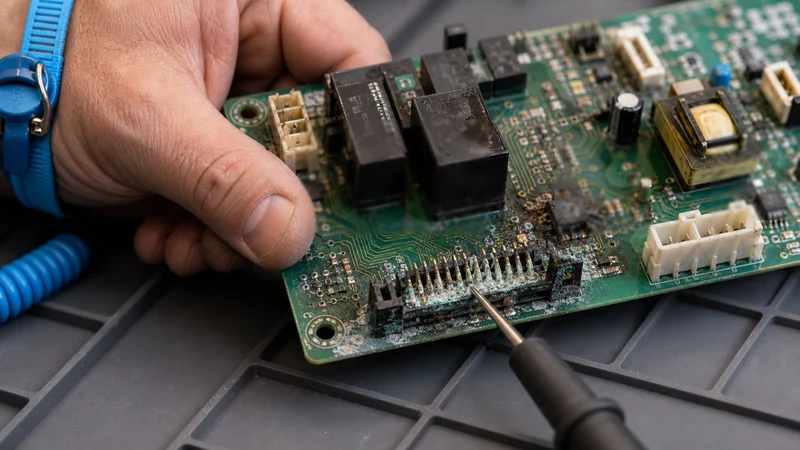
Where the river flooded, the mechanism is slower but no kinder. Salt residue bridges adjacent pins and raises resistance until a connection that was merely marginal finally opens — usually, again, during a voltage event. That is why we never swap a board on this street without inspecting the harness and compressor terminals beside it.

Corroded Sub-Zero control board removed from a Southbank kitchen flooded during Hurricane Irma

Read the Symptom

What the Unit Shows, and What It Means

Working ranges from the bench — never quotes, since the same symptom costs differently on a 632 than on a BI-42SD.

What you observe after a storm What it usually points to Working range
Lights on, control panel dark and silent Brownout lock or a surge-killed board — the BI-series signature $550–$1,100
Runs nonstop, slow to pull back down to 38°F Normal 24-hour recovery, or a condenser overdue for cleaning $0–$550
EC50 or EC40, or a steady service light A worn board writing phantom codes, or a real long-run fault $250–$1,100
Green corrosion on harness pins (flood-area homes) 2017 brackish residue — clean and seal, do not just replace $550–$1,100
Still warm after a full day, compressor straining Surge reached the sealed system — compressor or evaporator $1,000–$3,000

Prevention

What to Do Before the Next Season

Most of the damage in this entry is avoidable, and none of the prevention is exotic. The order below is the one we recommend to every household we visit, from the column pairs on River Road to the compact built-ins in the Epping Forest condominiums.

  1. Install whole-home surge protection at the service entrance — the single most effective measure, and the only one that reaches a hard-wired built-in.
  2. Add a dedicated, properly grounded circuit for the refrigeration if the unit still shares one with the rest of an old kitchen.
  3. If you evacuate ahead of a named storm, cut the dedicated breaker once the storm is close; a disconnected board cannot take the restoration spike.
  4. After power returns, allow the full 24 hours before judging the unit, and resist cycling the breaker repeatedly — the steps are laid out in our outage recovery note.
  5. Keep the condenser clean on a six-to-twelve-month calendar so a storm does not arrive on top of a coil already running hot.

Weighing the Guards

Which Protection Actually Reaches a Built-In

Not all surge protection is equal, and the difference matters most for a hard-wired Sub-Zero with no plug to guard. Here is how the options compare.

Protection What it actually covers Cost and verdict
Plug-in point-of-use strip Only the spike through one receptacle — and a built-in has no plug to use it $25–$80; little help for hard-wired refrigeration
Whole-home service-entrance suppressor Every circuit the panel feeds, including the dedicated built-in line $900–$1,200 installed; the measure that reaches the board
Dedicated, grounded circuit for the unit Isolates the refrigeration from the rest of an old kitchen's load Electrician's quote; pairs well with the suppressor above
Generator through a proper transfer switch Clean, regulated power during the outage itself Varies; only safe with conditioned output, never a backfeed cord

For a unit that has already taken a hit, the repair side of this story sits on our error-code reference and, where a surge reached the compressor, our sealed-system page.

From the Files

A Southbank Board, Eight Years After the Flood

Educational diagnostic scenario — composed to show the method, not a customer account.

A built-in french-door unit in a Southbank condominium runs without complaint for years, then goes dark-paneled the morning after an August thunderstorm, interior lights still glowing. The owner has cycled the breaker four times by the time we arrive. The board shows the brownout-lock signature, but pulling it reveals the real story: green bloom across three harness pins, the residue of brackish water that filled the building's lower level under Irma in 2017.

The honest repair is not a board alone. We replace the failed board, clean and seal the corroded connectors, and confirm the compressor terminals are sound before closing up — then recommend a panel-level surge device, because the next storm is a matter of when, not if. A board swapped without addressing the corrosion and the surge exposure would have failed again by spring. The lesson is the one this whole entry turns on: in San Marco, you repair the weather, not just the appliance.

Arrange a Visit from the Workshop

Weekday appointments across San Marco, San Jose, and Epping Forest — gate clearance arranged before we arrive.

(904) 893-3248 · Monday–Friday, 7:30 am – 5:30 pm

Correspondence

Storm and Surge Questions

Does a point-of-use surge strip on the wall outlet protect a built-in Sub-Zero?

Only partly, and often not at all on a true built-in. Most integrated and Classic BI units are hard-wired to a dedicated circuit with no accessible plug to guard, and even a plug-in strip clamps only the spike arriving through that one receptacle. The restoration surge San Marco sees travels the whole panel. Whole-home protection at the service entrance, roughly $900 to $1,200 installed, is the protection that actually reaches the appliance.

How can a flood from 2017 still be killing boards in 2026?

Because brackish corrosion is slow and quiet. Salt-laden water leaves a film on connector pins and board traces that draws moisture and oxidizes for years, gradually raising resistance until a marginal joint finally opens — frequently during the next voltage event. We routinely pull boards from River Road and Southbank kitchens whose green pin-bloom dates plainly to Irma, even when the unit ran fine until last week.

My panel went dark but the lights still work — is the whole board gone?

Not necessarily. Lights-on, panel-dark is the brownout-lock signature, and sometimes a controlled power-down for several minutes releases a board that merely latched. Often, though, the restoration spike has wounded the logic side, and the board needs replacement in the $550 to $1,100 range. We test before condemning, because a board swapped without finding what killed it tends to fail a second time.

Should I run the kitchen on a generator during an outage?

Only through a properly installed transfer switch with clean, regulated output. A portable generator feeding the house through a backfeed cord can deliver dirtier voltage than the grid, and a sensitive Sub-Zero control board does not distinguish a generator sag from a utility one. If you rely on backup power, have an electrician confirm the output is conditioned before a column or compressor depends on it.

Is it worth protecting a unit that is already twenty-five years old?

In San Marco, usually yes. A legacy 600-series or integrated unit set into 1920s millwork is far cheaper to protect than to replace, since replacement drags carpentry into the bill and quickly approaches five figures. A whole-home surge device shields not just the refrigeration but the wine cabinet, the range electronics, and everything else the panel feeds — sensible economics for an old house full of expensive equipment.

Is a whole-home surge device a one-time install, or does it wear out and need replacing?

It is installed once but it is a consumable, not a forever part. A service-entrance suppressor sacrifices itself absorbing spikes, and after a season of heavy lightning — or a single large event — its protection can be spent while it still sits on the panel. Better units carry a status indicator; check it after any major storm, and plan to replace the module every few years in a market that leads the country in cloud-to-ground strikes.

Lightning struck near the house and now several appliances are odd — is the Sub-Zero board the priority?

Triage by cost and irreplaceability. A nearby strike can induce a surge across the whole panel, so the Sub-Zero board — $550 to $1,100, and set into cabinetry that resists replacement — usually ranks ahead of a freestanding appliance with an accessible plug. Have the refrigeration and any built-in wine storage checked first, document what each shows, and let the diagnosis, not the panic, set the order of repairs.