Skip to content

San Marco · Jacksonville, Florida 32207

Monday–Friday, 7:30 am – 5:30 pm

(904) 893-3248
Sub-Zero Service San Marco
Menu

Repairs · Sealed System

Sub-Zero Sealed System & Compressor Repair in Jacksonville

The most consequential repair in refrigeration, undertaken the way it should be — proof first, figures second, work third.

Sub-Zero Service San Marco performs sealed-system and compressor work across 32207 and 32217 — compressor replacement at $1,000–$2,000, evaporator and full circuit repairs at $1,500–$3,000. No figure is committed to writing until airflow, electrical, and pressure evidence all point the same direction, and we show you that evidence.

For Sub-Zero repair across San Marco and the river streets, ring the workshop at (904) 893-3248 or book online.

Revised for accuracy, 13 June 2026

(904) 893-3248 · Monday–Friday, 7:30 am – 5:30 pm

First Principles

What Is a Sealed System, and Why Is It Different?

The sealed system is the refrigerant circuit itself — compressor, condenser, evaporator, and the tubing that joins them — closed at the factory and meant never to be opened. Everything else on a Sub-Zero® can be unplugged and exchanged; this cannot. Opening it means recovery equipment, brazing, a deep vacuum, and a precise recharge, which is why the trade treats sealed-system work as its own discipline.

It is also where the gravest misdiagnoses happen. A refrigerator with a dust-choked condenser behaves remarkably like one with a refrigerant leak, and the difference between those two diagnoses is several thousand dollars. Our rule is unsentimental: the cheaper explanations on the refrigerator bench must be disproven, in order, before this page’s figures enter the conversation.

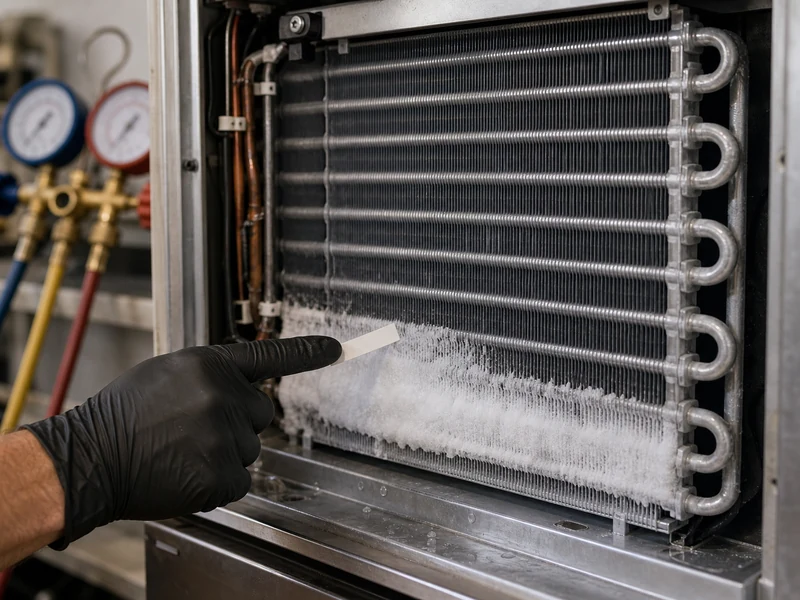
The evaporator tells most of the truth. A healthy charge frosts the coil evenly, end to end; a leak frosts four to eight inches and quits. That pattern — notorious on the 561’s fridge side and familiar across the legacy fleet — is photographed and shown to you before we discuss money.

Partial frost pattern on a Sub-Zero evaporator coil indicating a refrigerant leak, marked for the owner during diagnosis

The Ledger

Repair Path, Proof Required, and the Caveat

Repair path Proof we require first Figure & caveat
Compressor replacement Electrical tests at the terminals plus pressure readings ruling out a leak $1,000–$2,000; one long visit once parts arrive
Evaporator replacement Partial frost pattern photographed and pressure decay confirmed $1,500–$3,000; panel access decides the labor
Leak search and recharge Documented loss of charge with no visible failure point From $700; honest odds stated — some leaks hide for years
Dual-system work on PRO units Each circuit diagnosed independently — one side healthy proves nothing about the other Quoted per circuit; the 48-inch units are two-technician jobs
Declining the work Multiple systems failing at once on one cabinet $0 beyond diagnosis; we say so plainly and put it in writing

Matters of Record

The Figures That Frame a Repair-or-Replace Decision

A documented legacy rebuild: roughly $2,500 against $14,000

Replacing the evaporator and heat exchanger on a thirty-year-old 48-inch side-by-side runs in the neighborhood of $2,500. Replacing the unit — once a new built-in and the cabinetry alterations of a 1920s kitchen are priced — approaches $14,000. The arithmetic is why these repairs exist.

Specialized refrigeration labor runs $150–$250 per hour

That is the prevailing range for sealed-system-qualified technicians in premium Florida markets. It is honest money for work involving recovery equipment, brazing, and deep-vacuum standards — and a useful yardstick against any quote that seems improbably cheap.

A Sub-Zero is engineered for twenty years and more

The manufacturer builds to a two-decade standard, and units in San Marco routinely exceed it. A sealed-system repair on a sound cabinet is not life support; it is the second half of a service life the appliance was always designed to deliver.

The Tells

Which Symptoms Actually Point at the Sealed System?

Most warm-box complaints never reach this page — they end at a fan, a coil, or a gasket. These are the signs that genuinely implicate the refrigerant circuit, and the cheaper fault each is most often confused with.

What you observe Sealed-system reading it suggests Cheaper fault it mimics
Frost on only the first few inches of the evaporator Low refrigerant charge — a leak somewhere in the circuit None; this pattern is the genuine signature
Compressor runs nonstop yet the box stays warm Lost charge or a failing compressor Dust-choked condenser starving the system of heat rejection
A faint hiss or an oily film near the coil or joints Active refrigerant leak with oil migrating out Condensate residue, which is harmless and water-based
Compressor hums then clicks off within seconds, repeatedly Seized or hard-starting compressor A failed start relay or capacitor — far cheaper, checked first
One side of a dual-refrigeration unit warm, the other perfect A leak isolated to that circuit alone A fan or thermistor serving only the warm compartment

The pattern that arrives gradually with a clean coil is the one worth a gauge; the rest usually resolve on the refrigerator bench for a fraction of the cost. That triage is the whole reason this page comes last in the diagnostic order, not first.

A Worked Example

Repair-or-Replace Arithmetic on a 1996 532

Set the abstraction aside and run real numbers on a real cabinet. A 1996 Sub-Zero 532 — the 48-inch side-by-side from the 500 generation — develops a fridge-side evaporator leak in a Granada kitchen, and the data tag confirms the unit is otherwise sound: original compressor quiet, condenser clean, board healthy.

  1. The repair: evaporator and heat-exchanger replacement, recovery, deep vacuum, and recharge — roughly $2,500 on a cabinet this size, completed in place across one long visit.
  2. The replacement: a comparable new 48-inch built-in, plus the cabinetry alterations a 1920s kitchen demands to seat it — approaching $14,000 once the carpentry is priced.
  3. The lifespan math: a maintained Sub-Zero is engineered for twenty-plus years and routinely exceeds it, so a sound 532 has real service life left to recover.
  4. The disqualifier: if that same 532 also showed a tired compressor and a corroded board, the arithmetic flips, and we would say so plainly rather than stack repairs on a failing cabinet.

The lesson the legacy fleet keeps teaching: the cabinet, not the compressor, usually drives the decision in San Marco. Where the millwork is irreplaceable, a five-figure replacement makes a four-figure repair the obvious choice — the same logic that keeps the Classic BI cabinets in service here long after their first board failure.

The Neighborhood’s Cases

Why San Marco Produces So Much of This Work

The houses explain it. In the Mediterranean Revival blocks around Granada and the Square, a built-in often stands in cabinetry that predates the appliance by half a century, and no replacement unit will slide into that millwork without carpentry nobody wants. The no-replace bias here is architectural, not sentimental — and it makes a $2,000 compressor an easy decision where elsewhere it might be a debate.

Storm history contributes its share. Compressor terminals and board connectors in kitchens that took Irma’s 2017 water corrode on a long fuse, and a unit that stops cooling years later is sometimes finishing a story the flood began. The legacy fleet adds the rest: the 700 Series integrated units and the early Classic BI cabinets are now deep into the years where refrigerant circuits earn attention. The workshop line is (904) 893-3248 — or request a visit through the online appointment page — and we will start with the evidence, as always.

Arrange a Visit from the Workshop

Weekday appointments across San Marco, San Jose, and Epping Forest — gate clearance arranged before we arrive.

(904) 893-3248 · Monday–Friday, 7:30 am – 5:30 pm

Correspondence

Sealed-System Questions, Answered Without Varnish

How do you confirm a refrigerant leak before quoting sealed-system work?

Three kinds of evidence, gathered in order. Airflow first — a clean condenser and working fans, because a starved system mimics a leaking one. Electrical second — sensors and relays verified, so the compressor’s behavior can be trusted. Pressure last — gauge readings and the frost pattern on the evaporator itself. Only when all three agree do we write a sealed-system figure, and we photograph what we found.

Is a compressor replacement sensible on a unit from the 1990s?

Often, yes — arithmetic favors it more than intuition does. A compressor runs $1,000 to $2,000 installed, against roughly $14,000 to replace a 48-inch built-in once cabinetry alterations enter the bill. A 1990s Sub-Zero that has been maintained is built to accept that repair and continue for years. What changes the answer is a unit with several systems failing at once; then we say so and step back from the work.

How long does sealed-system work take, and does the unit leave the kitchen?

The unit stays home. We bring the work to it — recovery of the old refrigerant, the brazing, the deep vacuum, and the recharge all happen in place, typically across one long visit once parts are in hand, with a return check afterward. The deep vacuum is the slow, unskippable part; moisture left in a refrigerant circuit destroys the repair from the inside within a year or two.

Why did frost cover only a few inches of my evaporator coil?

That partial frost line — four to eight inches and then bare metal — is the classic portrait of a low refrigerant charge. The little refrigerant remaining boils off at the coil’s entrance and frosts only there. It is especially familiar on the 561, whose fridge-side evaporator leaks are notorious in the trade. A full, even coat of frost means the charge is healthy and your problem lives elsewhere.

Is brazing safe inside an older San Marco house?

Handled properly, yes. We shield the work area, keep an extinguisher staged, manage the torch with the same respect the house’s heart-pine and plaster deserve, and ventilate as we go. The nitrogen purge we run through the lines during brazing protects the refrigerant circuit as well — it prevents oxide scale from forming inside the tubing, which matters as much to the repair as the flame’s behavior matters to the room.

My older Sub-Zero uses R-134a — can it still be repaired, or is the refrigerant banned?

It can be repaired. R-134a is being phased down for new equipment, not pulled from service, and it remains available for repairing the units already in San Marco kitchens. We recover and recharge to the unit’s factory spec rather than substituting, because a Sub-Zero’s capillary and compressor are matched to a particular refrigerant. The legacy 500 and 600 units may use earlier refrigerants still; we identify the charge from the data tag before any recovery begins.

How do dual-refrigeration PRO and BI units change a sealed-system repair?

They double the diagnosis. A dual-refrigeration cabinet runs two independent sealed systems — one for the fresh-food side, one for the freezer — so a healthy reading on one circuit proves nothing about the other. We gauge and frost-read each side separately, which is why a quote on these units is per circuit. On the 48-inch PRO, the unit’s near-thousand-pound mass also makes it a two-technician job, a factor we state at booking.

If the leak cannot be found, what are my honest options?

Some leaks hide — a slow weep at a brazed joint or inside a foamed-in line can resist detection even with electronic sniffers and dye. When that happens we say so plainly. The choices are a leak-search-and-recharge that buys time with stated odds, opening suspect sections for inspection, or, on a cabinet already tired elsewhere, stepping back from the work entirely. We will not braze blindly and bill you for a repair we cannot stand behind.